
Building a villa is a large project that moves through successive stages, each built on the one before. If you know these stages in advance, you can follow the contractor knowingly and know what to check before moving on. In this article we explain the stages of building a villa in the Eastern Province, from preparing the plot to handing over the shell, and what comes after.
1. Study, design and permits
The journey starts before the first dig. An engineering office prepares the architectural, structural, electrical and plumbing drawings, and the building permit is issued through the Balady platform. This is when the family decides what it needs: the number of floors, a roof annex, a basement if any, and floor heights. These decisions are hard to change once concrete is poured.
2. Soil testing and site preparation
A soil test determines the right type and depth of foundations and whether the ground needs replacing. In some coastal parts of the Eastern Province the water table is high, so the design needs special insulation and foundation treatment. The site is then levelled and the building outline and levels are set out.
3. Excavation, soil replacement and foundations
The site is excavated to the required level, and weak soil is replaced with suitable soil compacted in layers where needed. Plain concrete is then poured, and the reinforced footings and ground beams are built. Then comes the most important step in protecting the building: insulating the foundations and footings against moisture and salts before backfilling.
4. The concrete structure (shell)
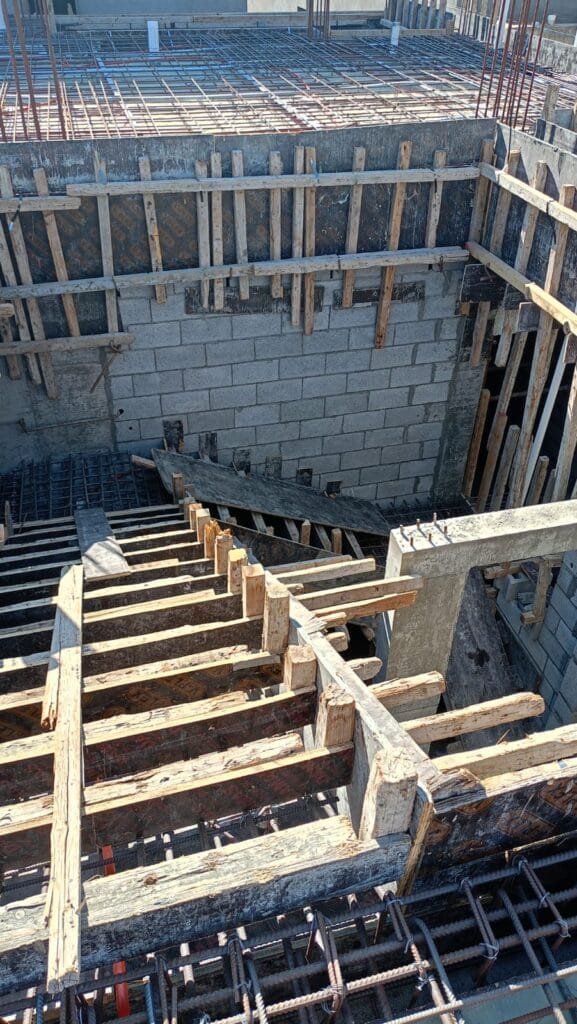
Columns and then slabs are built floor by floor. Reinforcement and formwork are checked before every pour, and the concrete is cured by spraying it with water, because the Eastern Province summer heat dries the surface quickly and can cause cracks. In buildings that need open spaces with few columns, such as showrooms, post-tension slabs are used.
Power Maas carries out this stage as part of its service Concrete Structure and Building Works, for example a residential villa in Danat Al-Ramis, Qatif on an 800 m² plot, with a ground floor, a first floor and a roof annex.
5. Blockwork
After the structure, the external and internal walls are built in block according to the plan, leaving openings for doors and windows. Insulated block is preferable for external walls, as it reduces heat transfer and air-conditioning use.
6. Electrical and plumbing installation
Electrical and plumbing conduits are laid inside the slabs before they are poured, then inside the walls after blockwork. This stage is hidden once plastered, so any mistake costs a lot later. It must be done by a specialist team, and the networks must be tested before they are closed. Power Maas does this with a dedicated department as part of its service Electrical and plumbing installation.
7. Roof insulation
The roof is the part most exposed to sun and rain. It receives waterproofing to prevent leaks and thermal insulation to reduce heat entering the building, in line with Saudi Electricity Company requirements for thermal insulation. Details are in our service Waterproofing and thermal insulation and in our article on the importance of thermal insulation.
8. Shell handover, then finishing
When the structure, blockwork, installations and insulation are complete, the building is a shell ready for finishing: plastering, painting, flooring, gypsum, facades, and fitting lighting and sanitary ware. You can do the finishing with the same contractor or another, but working with one contractor keeps responsibility for leaks and faults clear. Read about this stage in Architectural Finishing.
What to check at each stage
- Before pouring the foundations: footing dimensions, reinforcement and footing insulation.
- Before pouring each slab: reinforcement, formwork and the electrical and plumbing conduits inside the slab.
- After pouring: curing the concrete with water, and not striking the formwork too early.
- Before plastering: installations complete and the water network tested for leaks.
- After roof insulation: a flood test with water to make sure there are no leaks.
Frequently Asked Questions
How long does it take to build a villa?
It depends on the villa’s size, number of floors and the nature of the ground. We give a clear estimate of the timeline before starting and stick to the agreed schedule.
Do you work in every city of the Eastern Province?
Yes. We are based in Qatif and carry out projects across the Eastern Province, including Dammam, Khobar, Dhahran, Jubail and Al-Ahsa.
Planning to build a villa? Contact Us or call +966 56 683 7797 so we can learn about your plot and requirements and send you an itemised quote.